

Quick answer: The best way to find estate sales is to search a listing site that covers your state and city, check a day or two before sales open (that is when most listings go up), read the photos and terms on each listing, and plan your route by opening time. Start with the EstateSail Sale Locator.
This guide walks through where estate sales are listed, how to search them, how to read a listing, and how to plan a route so you reach the items you care about first.

Where estate sales are listed
Estate sales are usually posted in a few places. Checking more than one gives you the fullest picture of what is open near you.
- Estate sale listing sites. These collect sales from many companies in one place, sorted by location. The EstateSail Sale Locator lists sales nationwide by state and city.
- Local estate sale company pages and email lists. Most companies post their upcoming sales on their own website and send them to an email list. If you shop the same area often, sign up with the two or three companies you like best.
- Community boards and local papers. Some sales still appear in the classifieds, on library or grocery store boards, and in neighborhood groups.
How to search the Sale Locator
The Sale Locator is organized the way most shoppers think: state first, then city.
- Open the Sale Locator.
- Pick your state, for example California or Florida.
- Pick your city to see sales nearby, for example Anaheim.
- Open a listing to see dates, hours, photos, and terms.
Maps show an approximate location until the company releases the full address. Many companies release the address shortly before the sale opens, so check back if you only see the general area.
When sales get posted and when to look
Most companies post a sale several days before it opens and add photos as the house is set up. A good habit is to do your main search a day or two before the sale starts, when listings are most complete.
A few things to know about opening day:
- Lines form early at popular sales. Serious shoppers and resellers often arrive before the doors open.
- Numbers or sign-in lists are common. The first people in line get a number or sign a sheet, and entry happens in that order. Some companies use a digital check-in instead.
- Read the listing for line rules. Many companies say when numbers are handed out and whether you can hold a spot.
How to read an estate sale listing
A listing tells you most of what you need to decide whether a sale is worth the drive.
- Dates and hours. Note the opening time for each sale day. Hours often differ from one day to the next.
- Photos. Look for the categories you collect or resell. Photos are usually a sample, not everything in the house.
- Payment methods. Many sales take cards as well as cash. If the listing does not say, bring both.
- Terms. Most items are sold as is. Check whether purchases must be paid for and removed the same day, and whether large items need to be picked up later.
- Discount days. Many sales lower prices on the last day, often by 50 percent. Popular items are usually gone by then, so it is a trade off between selection and price.
Plan your route
Once you have a short list, plan the order before you leave.
- Rank by what you want most. Go to the sale with the items you care about first, especially if it is likely to have a line.
- Group by opening time. If two sales open at different times, start with the earlier one.
- Group by distance. Keep sales in the same part of town together so you are not crossing back and forth.
- Leave room for a return trip. If a sale has a discount day, note it so you can come back for items that are still there.
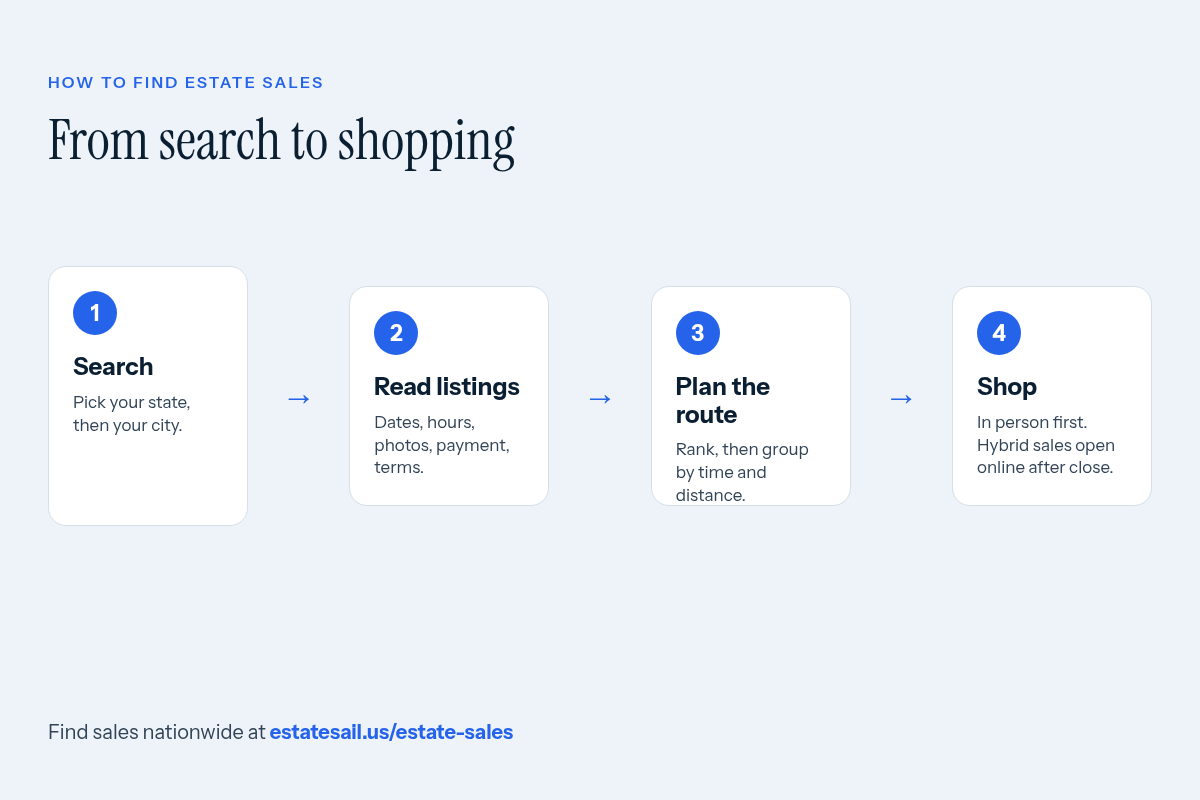
Shopping online after the in-person sale closes
Some estate sales are hybrid. The in-person sale runs first, and the online sale opens after the in-person day closes. That lets you buy remaining items without being at the house, usually with a set pickup window.
You can browse items for sale online in the EstateSail marketplace. If you run sales and want to learn how this works on the company side, see our guide to hybrid estate sales online.
FAQ
When are estate sales usually held? Most estate sales run over the weekend, often for two or three days. Some start earlier in the week. Each listing shows the exact dates and hours.
When do estate sales get posted? Most companies post a sale several days ahead and add photos as setup finishes. Checking a day or two before opening gives you the most complete listings.
Are prices negotiable at estate sales? It depends on the company. Some accept offers, especially on larger items or later in the sale. Others keep prices firm until a discount day. Ask politely.
Do estate sales take cards? Many do. The listing usually lists accepted payment methods. If it does not, bring cash as a backup.
What does 50 percent off day mean? On the last day, many sales cut remaining prices in half. Selection is smaller, but prices are lower.
Find sales near you
Ready to look? Find estate sales in your state on the Sale Locator, then pick your city to see what is open near you.