
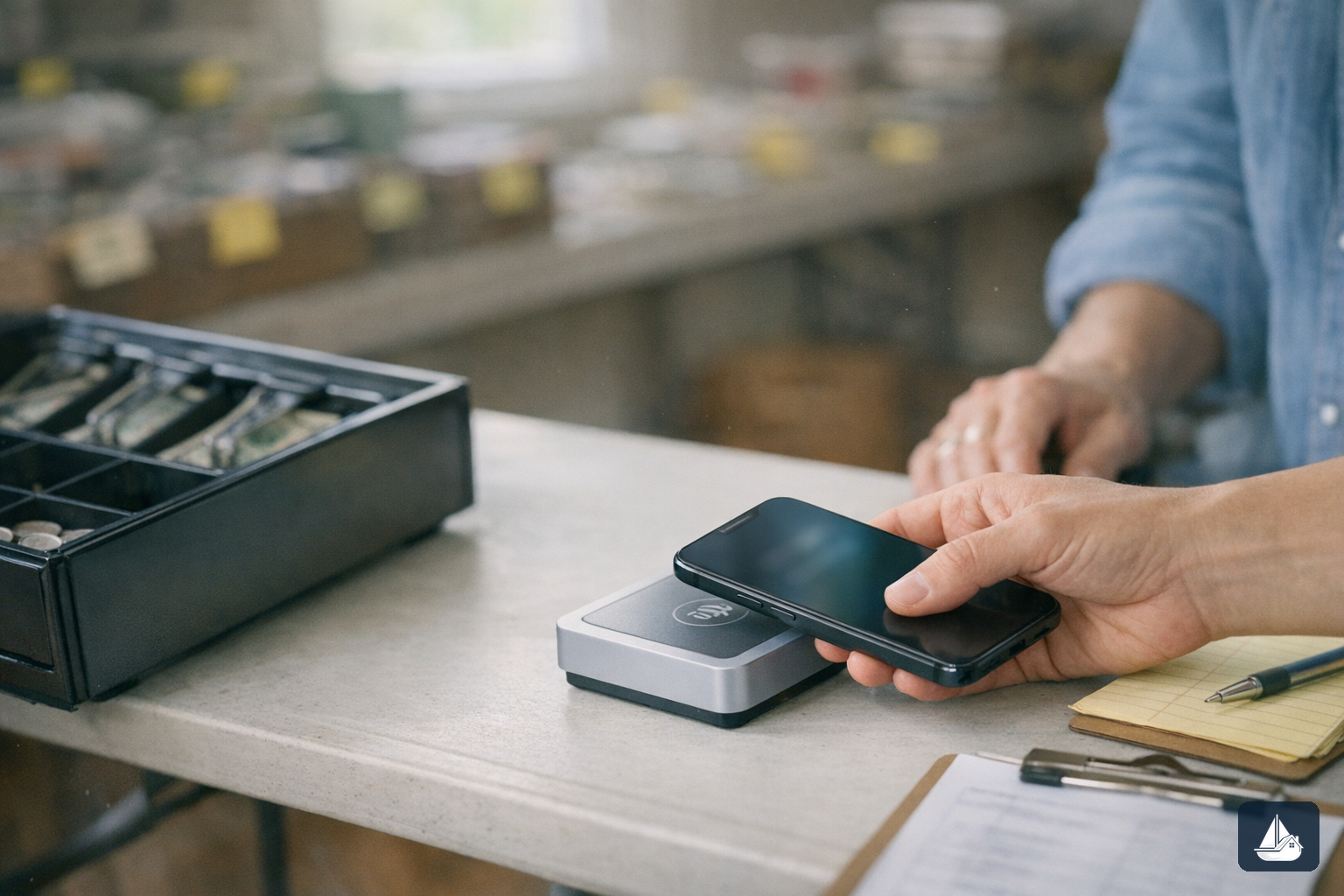
Tap to Pay on iPhone lets estate sale crews take contactless cards and wallets on a compatible iPhone—iPhone XS or later—without lining up a separate card terminal for every register. For liquidators, that means fewer gadgets in the tote, faster card lanes on a busy Saturday, and a tap to pay estate sale checkout that still pairs with a familiar Square path when you want a reader or an iPad register in the mix.
This is a practical hardware-and-checkout guide for professional liquidators—not a gadget brochure. Steal the habits that fit your houses.
Why Tap to Pay matters on sale day
Card buyers don’t care which processor logo is on the table. They care that the line moves. On a busy open, “wait while I dig out the reader” is how you lose the calm you earned at check-in.
Tap to Pay on iPhone helps when:
- You’re running multi-register checkout on phones you already own
- A second or third lane needs cards now, not after another dongle arrives
- You want contactless without a brick of hardware in every tote
- The register and catalog stay in one flow—not “scan here, pay in a separate app with no sold trail”
It’s not magic. Cash still happens. Some buyers still swipe or insert. But contactless is the weekend default for a huge share of shoppers—and your porch shouldn’t look like a trade-show booth of orphaned terminals.
For the full calm run-of-show, keep estate sale day checklist handy.
What you need (accurate hardware)
iPhone for Tap to Pay
Apple’s Tap to Pay on iPhone works on iPhone XS and later. Older phones can still help with inventory, photos, or door duty—they just aren’t the contactless antenna for this feature.
Practical crew notes:
- Charge overnight; bring a battery pack
- Keep iOS reasonably current—payment features track current OS expectations
- Passcode on; Date & Time set to automatic
- If your case holds extra cards against the phone, pull them before you enable Tap to Pay—accidental self-charges are a real “why did my Amex ping?” moment
Square path too
Estate sale checkout isn’t Tap-to-Pay-only theater. Many crews already live in Square—readers, accounts, payouts, tax habits. Keep that path. Use Tap to Pay on compatible iPhones where it speeds the line, and keep Square readers (or your usual Square setup) for:
- iPads (Tap to Pay on iPhone is an iPhone feature; iPad registers typically need a reader)
- Buyers who need insert / magstripe
- Backup when a phone is down or updating
The winning pattern is both: phones tapping contactless, Square covering the rest—not a religious war between dongle and NFC.
Some operators also use Stripe elsewhere in their payment stack—fine if that’s how you bank. For sale-day Tap to Pay talk on this blog, we stay Square-led.
Keep the rest of the tote cheap
- Phones/iPads you already use in the field
- Compact Bluetooth label printer (~$30; NIIMBOT B1, not B21)
- Basic barcode scanner (~$30)
- Cash float that isn’t “twenties in a cookie tin”
Labels and scan checkout are what make Tap to Pay feel fast. Contactless on a cart you’re still typing by hand is just a prettier bottleneck. Still rebuilding totals from scraps? See ditching paper tickets.
Sale-day checkout flow that moves
- Assign lanes before open — Cash-heavy, card-heavy, floater. Multi-register means parallel carts, not one hero phone.
- Log in card paths on each device — Square where you use Square; Tap to Pay enabled on the XS+ iPhones that will take contactless. Test one small auth/void habit before early birds.
- Scan → cart → tender — Barcode labels on money items; lot the junk drawers. Don’t invent a second price language at the table.
- Offer contactless first — “You can tap here” beats hunting a reader under totes.
- Park carts for “I’ll grab my spouse” — Don’t rebuild a furniture cart from memory while the line grows.
- Same trail feeds settlement — Cards, cash, discounts, and solds land in one story so close isn’t archaeology.
Slow lines create pricing fights. Fast lines create return shoppers for your next sale—and cleaner packets for the family.
Tap to Pay vs “just Square alone”
Square alone is a real status-quo stack. Plenty of good companies run it. The gap shows up when Square is the whole weekend system: catalog elsewhere, labels elsewhere, door clipboard elsewhere, settlement rebuilt in Sheets.
| Job | Weak Saturday | Stronger Saturday |
|---|---|---|
| Door | Clipboard / yelling | Real check-in / queue |
| Prices | Gun + paper tickets | Catalog + scannable labels |
| Registers | One laptop or one Square brick | Multi-device carts |
| Cards | Hunt the reader | Tap to Pay on iPhone XS+ and Square where needed |
| Close | Envelope math | Checkout trail → settlement packet |
Tap to Pay is one lane of that story—not the whole product. Don’t sell your crew a contactless feature and leave them with paper tickets everywhere else.
Objections you’ll hear on the porch
“Do we need brand-new iPhones?”
No. iPhone XS or later is the Tap to Pay floor. Older devices still work for non-tap jobs. Field app life is iOS; web covers the office.
“What about iPads?”
Great for screen real estate. Plan on a Square reader (or your card path’s reader) for iPad lanes. Save native Tap to Pay for compatible iPhones.
“Won’t fees crush us?”
Card fees exist whether you tap, insert, or key. Decide pass-through vs absorb before open and stick to it—no sticky-note calculator at 11 a.m.
“What if signal dies?”
Charged phones, hotspot backup, a rehearsed fallback—not a second half-system of paper tickets the moment bars flicker. One source of truth beats two broken ones.
“Buyers still want cash / receipts.”
Fine. Cash float ready. Receipts in whatever path you already promise. Tap to Pay doesn’t cancel cash culture; it shortens the card half of the line.
FAQ
What phones work for Tap to Pay at an estate sale?
Tap to Pay on iPhone requires iPhone XS or later. That’s an Apple hardware floor, not a sales slogan. Confirm the register phones before Saturday—not while the HOA is watching the porch.
Can I still use Square if I use Tap to Pay?
Yes—and many liquidators should. Keep the Square path for readers, iPad registers, insert/swipe needs, and the account habits you already trust. Use Tap to Pay on compatible iPhones to add contactless lanes without a terminal parade.
Is Tap to Pay enough to ditch paper tickets?
No. Contactless speeds tender. Paper tickets still steal hours in pricing fights and settlement rebuilds. Pair tap checkout with catalog prices, scannable labels, and a clean sold trail—or you’ll just tap your way into the same Sunday spreadsheet. More in ditching paper tickets.
Do I need Tap to Pay on every crew phone?
No. Put it on the devices that will actually ring cards. Floor helpers can inventory and label without every handset taking Visa. Assign roles; don’t turn every pocket into a register by accident.
How does this fit a full estate sale software stack?
Tap to Pay / Square checkout sits with inventory, labels, check-in, multi-register carts, and settlements—the sale-day calm stack, not a standalone dongle story. Product map: features. Numbers: pricing.
Soft next step
If your current card plan is “whoever finds the reader first,” you’re leaving line speed—and calm—on the table. EstateSail is built for liquidators who want checkout that keeps up: scan carts on iPhone and iPad, Square where you need it, Tap to Pay on iPhone (XS+) where contactless wins, and a trail that still makes sense at settlement.
Your first sale is on me. Run the next house with registers that tap instead of dig, feel what a shorter card line does to the porch, and decide if you miss the dongle scavenger hunt. After that first real sale, most crews don’t.
When you’re mapping the full weekend, keep estate sale day checklist next to features and pricing—and kill the paper-ticket tax while you’re at it (ditching paper tickets).